
If you’ve typed “Is XRP a Good Investment” into Google recently, you’re not alone. XRP has quietly become one of the most searched cryptocurrencies of 2026, and for good reason — after years of legal limbo, Ripple’s token has finally stepped out from under its regulatory cloud, and the market is trying to figure out what that’s actually worth.
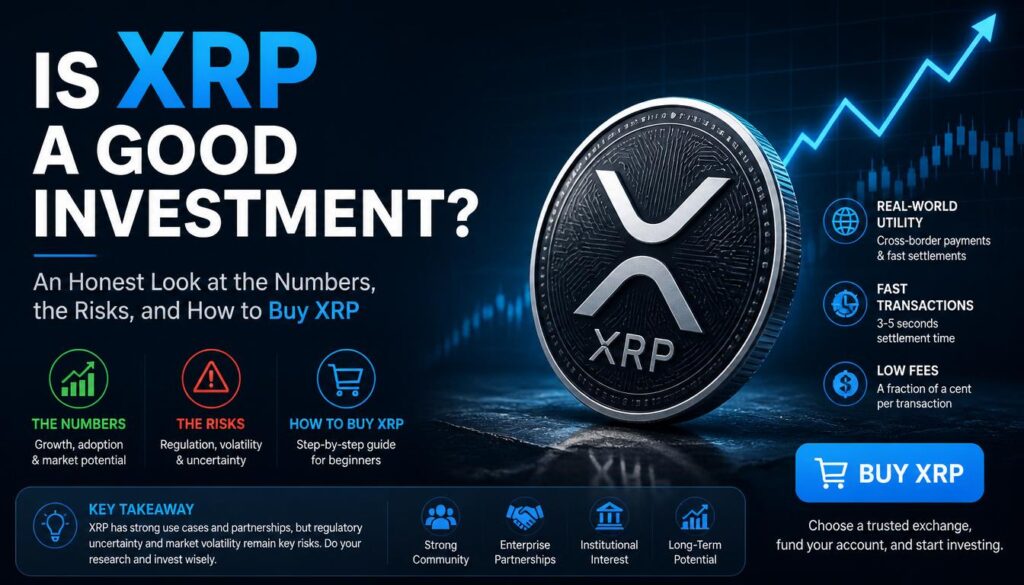
But “regulatory clarity” doesn’t automatically mean “guaranteed profit.” So let’s set the hype aside for a minute and actually walk through what’s happening with XRP right now — the price action, the fundamentals, the risks, and yes, exactly how to buy XRP if you decide it fits your portfolio. This isn’t financial advice; think of it as the research you’d want a friend to hand you before you make up your own mind.
Where XRP Stands Right Now
As of July 17, 2026, XRP is trading around $1.10, reflecting bullish market sentiment, with the 14-day RSI sitting at a neutral 53.18 and both the 50-day and 200-day moving averages clustered tightly around the $1.10 level. The MACD is positive, pointing to bullish short-term momentum, with the market currently expecting XRP to consolidate above $1.10 while attempting to retest resistance near $1.11.
That’s a very different picture from the highs of 2025. XRP’s all-time high stands at $3.65, reached on July 17, 2025 — meaning current prices sit well below that peak, even after a year of major legal wins for Ripple. If you’re wondering why a token with so much good news behind it hasn’t retested its highs, the honest answer is that crypto markets don’t move on fundamentals alone — they move on liquidity, sentiment, and macro conditions, and 2026 has been a choppier year for risk assets generally.
Zooming into the technical picture a bit more, one recent analysis painted a useful mental model. XRP has been trading around $1.09, boxed in by a descending trendline capping every rally since spring, with a hard floor near $1.00 and RSI hovering near 46 — a setup that’s committed to neither a clean breakout nor a breakdown. A daily close below that $1.00 psychological floor would open the door to a deeper move toward the $0.80 area, while the range above continues to run into resistance around $1.15 to $1.20.
The Big Story: Why XRP’s Legal Cloud Finally Lifted
To understand why so many people are asking about XRP again, you have to understand the backstory. For over five years, XRP was stuck in legal purgatory because of a lawsuit the SEC filed against Ripple Labs back in December 2020.
That chapter is now closed. The XRP SEC lawsuit resolved in 2026 through a joint dismissal approved by Judge Torres, with Ripple paying a reduced penalty while retaining the right to sell XRP in the United States. Specific numbers emerged in May 2026, confirming Ripple would pay approximately $50 million with no injunction — a dramatically better outcome for Ripple than the SEC’s original demands, which reportedly exceeded $2 billion at one point.
The practical upshot for everyday investors is significant. XRP purchased on cryptocurrency exchanges is now definitively not classified as a security, meaning only direct institutional sales with contractual promises fall under the earlier securities finding — retail investors can trade it without that legal ambiguity hanging over the token.
This resolution didn’t just clean up XRP’s legal status — it opened the door to something the industry had been asking for since 2020: exchange-traded funds.
The ETF Wave: Why Institutions Are Paying Attention
Once the legal fog cleared, institutional money started moving in fast. In early 2026, the SEC approved the first spot XRP ETFs, allowing pension funds and retirement accounts to gain XRP exposure without needing to manage crypto wallets or private keys directly. Those new spot ETFs pulled in $1.4 billion in fresh investment in just the first quarter of 2026 alone, a flood of institutional capital that has helped make XRP’s price action somewhat more stable than in years past.
Ripple itself has also been building out infrastructure to support this institutional shift. The company now holds a conditional national trust bank charter, which lets it act as an official custodian for digital assets — a credential that matters a great deal to large asset managers who need regulated custody solutions before they’ll allocate serious capital.
Ripple has also been expanding its regulatory footprint outside the U.S. The company has obtained full EU CASP (Crypto-Asset Service Provider) authorization under the MiCA framework, establishing Ripple as a fully regulated digital asset provider with an edge over some competing exchanges in the European market.
So… Is XRP a Good Investment?
Here’s where we have to be honest: nobody — not a crypto influencer, not an analyst, not this article — can tell you with certainty that XRP will go up. What we can do is lay out the case on both sides so you can weigh it against your own risk tolerance.
The bull case
- Legal certainty is a real catalyst. Years of “what if the SEC wins” uncertainty are gone, and that alone has removed one of the biggest overhangs on the token.
- Institutional access has expanded dramatically through spot ETFs, letting a much wider pool of capital — including retirement accounts — hold XRP exposure for the first time.
- Ripple’s actual business use case (cross-border payments) keeps expanding, and regulatory wins like the EU MiCA authorization strengthen the argument that XRP has utility beyond pure speculation.
- Some longer-range forecasts see meaningful upside if institutional adoption and cross-border payment usage continue to grow, though these are speculative and should be treated as scenarios rather than predictions.
The bear case
- XRP is still well below its all-time high, and price has struggled to reclaim old levels even with positive legal news already priced in.
- The token remains technically boxed in, with real resistance overhead and a support floor that, if broken, could trigger a meaningful further decline.
- Crypto broadly remains correlated and volatile. Even a token with clean fundamentals can get dragged down by broader market sentiment, macro shocks, or liquidity crunches that have nothing to do with XRP itself.
- Forecasts vary wildly — some sources cited above point to modest, single-digit-percentage annual growth, while others project XRP reaching $5, $10, or even higher by the end of the decade. That spread alone tells you how much uncertainty is still baked into any price target.
The reasonable middle-ground take, echoed across several analyses, is that XRP in 2026 looks like a catalyst trade sitting around a well-defined support level — if the broader legal and regulatory picture continues to improve and the market steadies, the current range could turn out to be an accumulation zone, but that outcome depends on quite a few things going right, not a guaranteed rebound.
What Actually Is XRP For? (A Quick Refresher)
It’s easy to get caught up in price charts and forget what the token is actually designed to do. XRP runs on the XRP Ledger, a blockchain built specifically for fast, low-cost payments — transactions typically settle in a few seconds for a fraction of a cent, which is a very different design goal than something like Bitcoin, which prioritizes decentralization and security over raw transaction speed.
Ripple, the company most closely associated with XRP, uses the token as a bridge currency in its payment network to help financial institutions move money across borders without needing to pre-fund accounts in every destination currency — a process that traditionally ties up huge amounts of capital in the correspondent banking system. That’s the core “utility” argument long-term XRP holders point to: unlike purely speculative tokens, XRP has an actual designed use case tied to a real business trying to solve a real, expensive problem in global finance.
Whether that use case translates into sustained price appreciation is a separate question from whether the technology works — plenty of useful technologies have underwhelming token economics, and plenty of speculative tokens have outperformed fundamentally “useful” ones, at least in the short term. It’s a factor worth weighing, not a guarantee.
Key Factors That Could Move XRP’s Price From Here
If you’re trying to decide whether XRP fits your portfolio, these are the variables actually worth tracking:
- Broader crypto market-structure legislation. Bills like the CLARITY Act, which aim to formally define how digital assets are regulated in the U.S., could further reduce uncertainty across the entire sector — and XRP, given its history with the SEC, would likely be one of the more sensitive tokens to that kind of news.
- ETF inflows and outflows. Since institutional money now has an easy on-ramp through spot ETFs, weekly and monthly flow data is becoming one of the clearest real-time signals of institutional sentiment toward XRP.
- Ripple’s business expansion. Growth in RippleNet adoption, new banking partnerships, and additional regulatory licenses (like the EU MiCA authorization) all feed into the long-term utility argument for XRP.
- Macro conditions. Interest rate policy, overall risk appetite, and Bitcoin’s price trend still heavily influence altcoins like XRP, regardless of token-specific news.
- Technical levels. Keep an eye on that $1.00 psychological support and the $1.15–$1.20 resistance zone — a decisive break in either direction tends to set the tone for the following weeks.
How to Buy XRP: A Step-by-Step Guide
If you’ve weighed the risks and decided you want exposure to XRP, here’s exactly how to buy XRP in 2026, whether you want to hold it directly or gain exposure through an ETF.
Option 1: Buy XRP directly on a cryptocurrency exchange
- Choose a reputable exchange. Major platforms like Coinbase, Binance, and Kraken all list XRP and are commonly used by both beginner and experienced investors. Compare fees, available payment methods, and whether the platform is available and licensed in your country before committing.
- Create and verify your account. Most regulated exchanges require KYC (Know Your Customer) verification — typically a government ID and sometimes proof of address — before you can deposit funds or trade.
- Fund your account. You can usually deposit via bank transfer, debit card, or in some regions, UPI or other local payment rails. Bank transfers tend to have lower fees than card payments.
- Place your order. Search for XRP, decide between a market order (buy immediately at the current price) or a limit order (buy only if the price hits a level you set), and confirm the purchase.
- Decide where to store it. You can leave XRP on the exchange for convenience, or move it to a personal wallet — such as a hardware wallet or the official XUMM/Xaman wallet — for greater control and security. If you’re holding a meaningful amount long-term, a self-custody wallet is generally considered the safer option.
Option 2: Buy XRP through a spot ETF
If you’d rather not deal with wallets, private keys, or exchange accounts, the new spot XRP ETFs offer a simpler route:
- Open a brokerage account (or use an existing one) that offers access to the specific XRP ETF you’re interested in.
- Search for the ETF ticker and review its expense ratio, fund size, and how closely it has tracked XRP’s actual price.
- Buy shares just like you would any other ETF — no separate crypto wallet or exchange account required.
- Hold it in a taxable brokerage account or, where permitted, a retirement account, which is part of why these ETFs have proven popular with institutional and retirement investors.
A few practical tips regardless of which route you choose
- Never invest more than you can afford to lose. This applies to every crypto asset, XRP included, given how much volatility remains even after the legal resolution.
- Dollar-cost averaging (DCA) — buying a fixed amount at regular intervals rather than all at once — is a common approach for investors who want exposure without trying to perfectly time the market.
- Watch out for scams. XRP’s popularity has made it a common target for fake giveaways and phishing schemes, especially on social media. Only use official apps and verified exchange websites.
- Understand the tax implications in your country before buying or selling, since crypto tax treatment varies widely and can meaningfully affect your actual returns.
Frequently Asked Questions
Is XRP a good investment in 2026?
It depends entirely on your risk tolerance and time horizon. XRP has clear legal resolution and growing institutional access through ETFs, but its price remains volatile, technically range-bound, and well below its all-time high. It’s not a guaranteed win — it’s a higher-risk asset with a genuinely improved fundamental backdrop compared to a few years ago.
How do I buy XRP safely?
Use a reputable, regulated exchange or a spot ETF through a brokerage account, verify your identity as required, and consider moving larger holdings to a self-custody wallet rather than leaving everything on an exchange.
What’s driving XRP’s price in 2026?
Primarily the resolution of the SEC lawsuit, the launch of spot XRP ETFs and resulting institutional inflows, Ripple’s expanding regulatory footprint (including EU MiCA authorization), and broader crypto market sentiment and macro conditions.
Could XRP go back to its all-time high?
It’s possible but far from guaranteed. XRP would need sustained institutional inflows, continued positive regulatory developments, and generally favorable crypto market conditions to retest and exceed its previous high. Forecasts on this vary widely across analysts.
Is it too late to buy XRP?
There’s no way to know for certain — that’s true of any asset at any price. What matters more than timing a “perfect” entry is whether XRP’s risk profile and long-term thesis fit your own financial goals and risk tolerance.
Final Thoughts
XRP in 2026 is a genuinely different asset than it was even two years ago. The legal uncertainty that hung over it for half a decade is gone, institutional money has a real, regulated way to gain exposure through spot ETFs, and Ripple’s underlying payments business keeps expanding its regulatory footprint globally. That’s a meaningfully stronger fundamental picture than XRP has had in years.
At the same time, none of that guarantees where the price goes next. XRP is still trading well below its highs, still technically range-bound, and still exposed to the same volatility and macro risk that shapes the entire crypto market. Whether it’s “a good investment” isn’t really a yes-or-no question — it’s a question of whether the risk-reward makes sense for your own portfolio, timeline, and comfort with volatility.
If you do decide to move forward, buying XRP itself is straightforward — a regulated exchange or a spot ETF will get you there in a few minutes. The harder part, as always, is making sure the decision fits your own financial plan rather than the headlines of the week.
This article is for informational purposes only and does not constitute financial or investment advice. Cryptocurrency investments carry significant risk, including the potential loss of principal. Always conduct your own research and consult a qualified financial advisor before making investment decisions.