
This guide lays out the specific Risk Management Rules for Passing Prop Firm Evaluations that consistently separate traders who pass from traders who don’t.Talk to anyone who’s failed multiple prop firm challenges, and a pattern usually emerges. It’s rarely a lack of trading knowledge that ends an evaluation early. It’s risk management, or more specifically, the absence of it. Traders who understand technical analysis, price action, and market structure still blow through drawdown limits because they never built the discipline to protect their downside first.
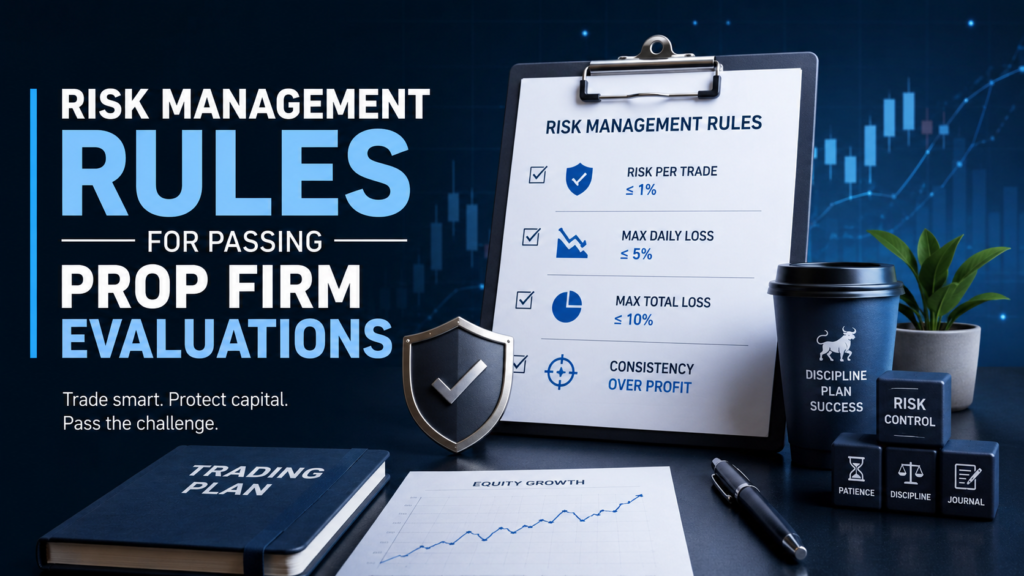
Prop firm evaluations aren’t really testing whether you can find good trades. They’re testing whether you can survive your own worst days without breaching a rule. That distinction changes everything about how you should prepare.
Why Risk Management Matters More in a Challenge Than in Personal Trading
When you’re trading your own account, a bad week is painful, but it’s rarely fatal unless you’re wildly overleveraged. In a prop firm evaluation, a single day that breaches the maximum daily loss limit ends the challenge instantly, regardless of how profitable your overall strategy might be over a longer timeframe.
This asymmetry means the usual advice of “just be profitable” isn’t enough. You need to be profitable while staying meaningfully inside hard boundaries that, if crossed even briefly, end everything. That requires a different mindset than most retail traders bring to their personal accounts.
Rule 1: Risk a Small, Fixed Percentage Per Trade
This is the foundation everything else builds on. A widely used guideline among funded traders is to risk no more than 0.5% to 1% of the account balance on any single trade. On a $100,000 account, that translates to a maximum risk of $500 to $1,000 per position.
This might sound conservative, especially compared to how some traders size positions on personal accounts, but the math matters here. If your maximum daily loss limit is 5%, risking 1% per trade means it would take five consecutive losing trades in a single day to breach that limit. Risking 3% per trade means it takes less than two. Small, consistent position sizing buys you the room to be wrong repeatedly without the evaluation ending in a single afternoon.
Rule 2: Know Your Daily Loss Limit Cold, and Build a Buffer
Don’t just know the firm’s stated daily loss limit. Build your own internal limit that sits comfortably inside it. If the firm’s hard limit is 5%, consider setting your personal stopping point at 3%. This buffer accounts for slippage, a trade that moves against you faster than expected, or simple human error in a fast-moving market.
Once you hit your internal daily limit, stop trading for the day. No exceptions, no “one more trade to win it back.” This single habit, more than almost any other, is what separates traders who pass evaluations from traders who don’t.
Rule 3: Understand Trailing vs Static Drawdown Before You Trade a Single Position
Many failed evaluations come down to a fundamental misunderstanding of how the firm calculates maximum drawdown. A static drawdown is measured from the account’s starting balance and doesn’t move. A trailing drawdown follows your account’s peak equity, meaning it can tighten even while you’re in profit.
If you’re trading a trailing drawdown account without accounting for this, you can find yourself in a position where unrealized open profit shrinks your available room to be wrong, sometimes to a dangerous degree, without you fully realizing it in real time. Read the firm’s specific drawdown methodology before you place a single trade, not after your account gets flagged.
Rule 4: Set a Maximum Number of Trades Per Day
Overtrading is one of the fastest ways to breach a daily loss limit, because each additional trade is another opportunity for something to go wrong, and fatigue tends to degrade decision quality as the session goes on. Cap yourself at a specific number of trades per day, whether that’s three, five, or whatever fits your strategy, and treat that cap as a hard rule, not a suggestion.
If you hit your trade limit without having found quality setups, that’s valuable information about market conditions that day, not a reason to lower your standards just to stay active.
Rule 5: Use a Consistent Risk-to-Reward Ratio
Aim for trades where your potential reward meaningfully exceeds your risk, commonly a minimum of 1.5:1 or 2:1. This matters because it means you don’t need an unrealistically high win rate to stay profitable. A trader with a 2:1 risk-reward ratio only needs to win roughly 40% of trades to be net profitable before accounting for costs, which builds in a margin of error that a 1:1 ratio simply doesn’t offer.
Rule 6: Avoid Increasing Size After a String of Losses
The instinct to “win it back” by increasing position size after a losing streak is one of the most common ways traders breach drawdown limits. It feels emotionally logical in the moment, but it’s mathematically backwards. A losing streak is exactly the time to reduce size, not increase it, because it signals either unfavorable market conditions or a temporary dip in your own execution quality, neither of which is solved by betting bigger.
Rule 7: Don’t Chase the Profit Target Near the Time Limit
As an evaluation deadline approaches, there’s a strong temptation to abandon your normal risk parameters in pursuit of hitting the profit target before time runs out. This is one of the most reliable ways to fail an otherwise well-managed challenge. If you’re close to the profit target with time remaining, patience will usually get you there. If you’re far from the target with little time left, it’s often better to accept a failed attempt and try again with fresh capital allocation than to blow through your risk rules chasing an unrealistic target.
Rule 8: Respect News Event Volatility
Even on firms that permit news trading, high-impact economic releases can create volatility and slippage that make normal position sizing behave unpredictably. Many funded traders choose to reduce size significantly or step aside entirely around major releases like central bank decisions or employment reports, specifically during the evaluation phase when there’s no cushion for a surprise move.
Rule 9: Track Your Metrics, Not Just Your P&L
Win rate and total profit tell you almost nothing about whether your risk management is actually sound. Track your average risk per trade as a percentage of account balance, your maximum intraday drawdown on both winning and losing days, and how often you’re trading near your daily loss limit. These numbers reveal patterns that raw profit and loss figures hide, and they’ll show you exactly where your process is fragile before a real breach happens.
Rule 10: Build in Recovery Days
After hitting your daily loss limit, or even after a smaller-than-limit losing day that still felt emotionally difficult, consider taking the next session off, or trading at reduced size. Evaluations are won over days and weeks, not in a single session, and trading through frustration or a desire to immediately recover losses is a common precursor to a rule breach.
Putting It All Together
- Risk 0.5% to 1% per trade as a baseline, adjusting only with strong justification.
- Set an internal daily loss buffer tighter than the firm’s actual limit.
- Understand exactly how your specific firm calculates drawdown before trading.
- Cap your number of trades per day to avoid overtrading and fatigue-driven mistakes.
- Maintain a minimum risk-to-reward ratio on every trade you take.
- Reduce size after losing streaks instead of increasing it.
- Resist the urge to chase profit targets as deadlines approach.
- Trade cautiously, or not at all, around major news events during the evaluation.
- Track process metrics alongside profit and loss.
- Allow yourself recovery time after difficult trading sessions.
How to Build These Risk Management Rules for Passing Prop Firm Evaluations
Knowing the rules intellectually and actually following them under live pressure are two very different things. Most modern trading platforms let you set hard stop losses on every position, which removes the temptation to move a stop once a trade starts moving against you. Some funded trading platforms also offer built-in risk dashboards showing your current drawdown relative to the firm’s limit in real time, which is worth checking before you start trading so you’re not calculating this manually mid-session.
Consider setting a daily loss alert, either through your platform or a simple spreadsheet you update after each trade, that notifies you the moment you’re approaching your personal buffer. Removing the need to mentally track this number while also focused on live price action reduces the chance of an emotional miscalculation during a stressful session.
Why Most Traders Underestimate Daily Loss Limits Until It’s Too Late
A daily loss limit sounds simple in the rule document, but its practical impact tends to surprise traders who haven’t lived through hitting one. The issue isn’t usually a single catastrophic trade. It’s a string of smaller losses across the session that compound faster than expected, especially when a trader begins increasing size slightly after each loss in an unconscious attempt to recover ground.
This is precisely why fixed, pre-decided position sizing matters so much. If your risk per trade never changes regardless of the day’s results, a losing streak simply ends the session within your daily buffer rather than breaching the firm’s hard limit. Traders who adjust size based on how the day is going, even without fully realizing they’re doing it, are the ones who most often find themselves breaching a limit they thought they had comfortable room within.
Frequently Asked Questions
What percentage risk per trade is too aggressive for a prop firm evaluation?
As a general guideline, risking more than 2% of account balance per trade is considered aggressive for most evaluation rule sets, since it significantly reduces the number of consecutive losses your account can absorb before breaching a daily or overall drawdown limit.
Should I use the same risk management rules on a funded account as during the evaluation?
Yes. The rules that got you through the evaluation are exactly the habits that will keep your funded account active and your payouts consistent. Loosening discipline after funding is one of the most common reasons traders lose funded accounts.
Is it better to risk a fixed dollar amount or a fixed percentage per trade?
A fixed percentage is generally preferred, since it automatically adjusts your dollar risk as your account balance changes, keeping your risk exposure proportionate whether you’re up or down for the evaluation period.
How do I know if my risk-to-reward ratio is actually sound?
Review your trading journal over a meaningful sample size, ideally 30 or more trades, and calculate your actual average risk-to-reward ratio and win rate together. A ratio that looks good in theory but isn’t reflected in your real trade history needs to be re-evaluated honestly.
Passing a prop firm evaluation isn’t about finding the perfect strategy. It’s about protecting a good-enough strategy from your own worst impulses long enough for it to work.
Final Thoughts
Every one of these rules exists because real traders broke real evaluations by ignoring them. None of this is theoretical. The traders who consistently pass prop firm challenges, and more importantly, stay funded afterward, aren’t necessarily the ones with the most sophisticated strategies. They’re the ones who treat risk management as the actual skill being tested, rather than an obstacle standing between them and the trades they want to take.
Before your next evaluation attempt, write these rules down, attach specific numbers to each one based on the firm’s exact requirements, and commit to following them regardless of how confident you feel in any individual trade. Confidence fades. Discipline, built into your process ahead of time, is what actually gets you funded.