
Ask ten traders whether a one-step or two-step prop firm challenge is better, and you’ll likely get ten different answers, most of them based on personal experience rather than an objective look at the trade-offs. Both formats exist for a reason, and both have genuinely helped traders get funded. The right choice depends less on which one is “easier” and more on how your trading style, patience, and risk tolerance line up with each structure.
This article unpacks exactly how each format works, where they diverge, and how to decide which one deserves your evaluation fee.
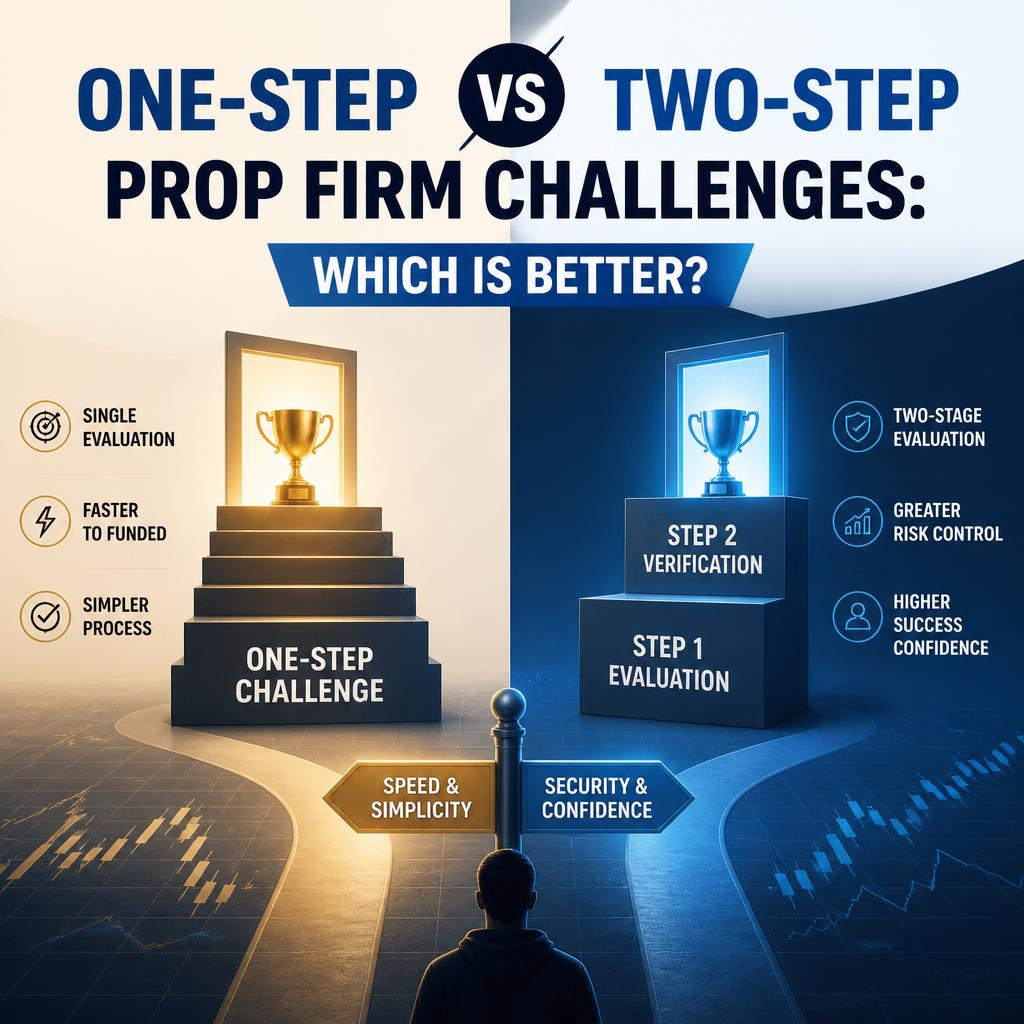
What Is a Two-Step Prop Firm Challenges?
The two-step model has been the industry standard for years, and it’s still what many traders picture when they think of a prop firm evaluation. It works in two distinct phases:
- Phase 1 (Challenge): Hit a profit target, commonly around 8-10% of the account balance, without breaching the maximum daily loss or overall drawdown limits.
- Phase 2 (Verification): Repeat a similar process with a lower profit target, often around 4-5%, again while respecting the same risk rules.
Only after clearing both phases do you receive a funded account and start earning your profit split. Time limits vary by firm, but many two-step challenges give traders 30 days per phase, with some offering unlimited time as long as the minimum trading days are met.
What Is a One-Step Prop Firm Challenges?
The one-step model strips out the verification phase entirely. You need to hit a single profit target, usually higher than a two-step Phase 1 target, often in the 8-12% range, while staying within the drawdown rules. Clear that one hurdle, and you move straight to a funded account.
Because the firm is taking on risk faster with less confirmation of your consistency, one-step challenges typically come with tighter drawdown limits and sometimes stricter daily loss rules to compensate.
Speed to Funding
This is the most obvious difference, and it’s usually the first thing traders consider. A one-step challenge gets you to a funded account faster, assuming you pass, because there’s no second phase to complete. If you’re confident in your strategy and eager to start earning a profit split as soon as possible, this speed advantage is real and meaningful.
A two-step challenge takes longer by design. Even with unlimited time limits, you’re mentally committing to two separate proving periods before any payout is possible. For traders who value speed above all else, this can feel like an unnecessary delay.
Risk Tolerance and Drawdown Limits
Here’s where the trade-off becomes clearer. Because one-step challenges compress the evaluation process, firms often tighten the risk parameters to protect themselves. A typical one-step account might have a lower maximum drawdown, for example 6% instead of 10%, and a lower daily loss limit than the equivalent two-step account from the same firm.
This means a one-step challenge, despite feeling faster, can actually be harder to pass for traders who don’t have tight risk control. A single volatile trading session that would have been survivable under a two-step firm’s looser drawdown rule could end a one-step attempt entirely.
Two-step challenges generally offer more breathing room, particularly in Phase 1, which can make them more forgiving for traders who are still refining their risk management or who trade a style with occasional larger drawdowns before recovery.
Cost Differences
One-step challenges often cost slightly more upfront for the same account size compared to two-step challenges, because the firm is compressing its due diligence into a single phase and pricing in that additional risk. However, if you fail a two-step challenge in Phase 2 after already passing Phase 1, you’ve effectively spent more time and, in some cases, money to get the same non-result as a failed one-step attempt.
When comparing total cost, factor in not just the sticker price of the evaluation, but the realistic likelihood of passing each phase given your trading history, and how much a failed attempt costs you in both money and time.
Psychological Pressure
This is an underrated factor that experienced traders will tell you matters more than the numbers on paper. A one-step challenge concentrates all the pressure into a single event. There’s no second chance to prove consistency after an initial pass. Every trade carries the weight of the entire evaluation.
A two-step structure, paradoxically, can feel both more and less stressful depending on the trader. Some find it reassuring to know they’ll get to demonstrate consistency twice, which reduces the fear that one lucky or unlucky trade defines the outcome. Others find the extended timeline mentally exhausting, since the anticipation of Phase 2 after clearing Phase 1 becomes a new source of pressure.
Know yourself here. If you perform better under a single, clearly defined test, a one-step challenge might suit your psychology. If you prefer proving yourself gradually and having a cushion against one bad phase, two-step is likely the better emotional fit.
Which Trading Styles Fit Which Format
- Scalpers and disciplined day traders with consistently tight risk control often do well with one-step challenges, since their drawdowns tend to be small and controlled by design.
- Swing traders who occasionally see larger unrealized drawdowns before a position plays out often benefit from the looser risk parameters of a two-step Phase 1.
- Traders still refining their edge are generally better served by two-step challenges, since the more forgiving Phase 1 limits give more room to learn without immediately failing the entire evaluation.
- Highly experienced traders with a proven, low-drawdown strategy may prefer the speed of a one-step format, since they’re less likely to need the extra cushion.
Profit Splits: Is There a Difference?
Profit splits between one-step and two-step challenges from the same firm are often similar, though some firms offer a slightly lower starting split on one-step accounts to offset the faster funding timeline and increased risk they’re absorbing. Always check the specific numbers rather than assuming parity, since this varies firm by firm and can meaningfully affect your actual take-home earnings.
A Side-by-Side Summary
- Time to funding: One-step is faster; two-step requires clearing two phases.
- Drawdown limits: One-step is typically tighter; two-step usually offers more room, especially in Phase 1.
- Cost per attempt: One-step tends to cost more upfront; two-step spreads risk of failure across two stages.
- Best for: One-step suits disciplined, low-drawdown traders; two-step suits traders who want more room to prove consistency gradually.
- Psychological load: One-step concentrates pressure into a single test; two-step spreads it across two, which some traders find easier and others find more draining.
What About Three-Step and Instant Funding Models?
While one-step and two-step remain the most common structures, it’s worth briefly noting the alternatives, since they represent the same underlying trade-off taken further in each direction. Three-step challenges add an additional verification phase beyond the traditional two-step model, typically offering even more generous drawdown limits in exchange for a longer overall timeline to funding. These can suit extremely risk-averse traders or those still building consistency who want maximum room for error before real capital is on the line.
Instant funding models sit at the opposite end, removing the evaluation phase entirely. You pay a fee, often higher than a comparable one-step or two-step evaluation, and begin trading a funded account immediately, sometimes with a lower initial profit split or more conservative risk parameters until you’ve demonstrated consistency. This suits traders who are highly confident in their strategy and simply want to skip the proving period, accepting a less favorable starting split as the cost of that convenience.
How Firms Price Risk Across Formats
Understanding why one-step challenges tend to have tighter limits helps explain the entire structure. A firm offering a two-step evaluation gets two separate data points on your trading behavior before committing real capital to your funded account. A one-step firm only gets one. To compensate for this reduced visibility into your consistency, firms typically tighten the drawdown and daily loss parameters on one-step offerings, effectively requiring you to demonstrate the same risk discipline in a shorter observation window.
This is also why instant funding accounts, which involve no observation period at all, often start with the most conservative risk parameters and lowest profit splits of the three models, gradually loosening as the trader proves themselves through actual funded performance rather than a pre-funding evaluation.
Frequently Asked Questions
Is a one-step challenge actually cheaper in the long run?
Not necessarily. While a single one-step attempt might cost less time, the tighter drawdown limits can lead to more failed attempts for traders without very disciplined risk management, which can make the total cost of eventually getting funded higher than a more forgiving two-step path.
Can I switch from a two-step to a one-step model with the same firm later?
Most firms allow you to purchase either evaluation type independently, meaning you can choose a one-step challenge for a future attempt even if your first evaluation was a two-step, as long as the firm offers both formats.
Do one-step challenges have a lower profit split as a trade-off?
This varies by firm. Some offer identical splits across formats, while others adjust the starting split slightly to account for the faster path to funding. Always check the specific numbers for the firm you’re considering.
Which format do most experienced funded traders recommend for beginners?
Many experienced traders suggest beginners start with a two-step model, since the more forgiving Phase 1 limits provide a gentler introduction to trading under real evaluation pressure before advancing to faster, tighter formats.
Neither format is inherently better. The question isn’t which challenge is easier in the abstract, it’s which one matches the risk profile you already trade with, honestly assessed.
How to Decide
Before choosing, pull up your own trading history or backtest results and answer honestly: what’s your typical maximum drawdown during a losing streak, measured as a percentage of account balance? If that number comfortably fits within a one-step firm’s tighter limits, the speed advantage is likely worth it. If your drawdowns tend to run higher before recovering, even with a profitable overall strategy, the extra cushion of a two-step Phase 1 could be the difference between passing and failing.
It’s also worth considering a hybrid approach. Some traders start with a two-step challenge on their first attempt with a new firm, since it typically offers a more forgiving introduction to that firm’s specific platform and rule enforcement, then move to one-step challenges on subsequent evaluations once they’re confident in how the firm operates.
Final Thoughts
The one-step versus two-step debate isn’t really about which format is objectively superior. It’s about matching the structure to your actual trading behavior, not your ego or your impatience to get funded. A faster path to funding means nothing if tighter drawdown limits cause you to fail repeatedly, spending more on evaluation fees than you would have with a slightly slower but more forgiving two-step process.
Take an honest look at your risk management data before choosing. The traders who succeed with either format aren’t the ones who picked the trendier option. They’re the ones who picked the format that already matched how they trade, and then executed their existing edge without trying to change their entire approach just to fit an unfamiliar rule set.