
Pass a prop firm challenge sounds simple on paper: hit a profit target, don’t breach the drawdown rules, done. In practice, the majority of traders who attempt these evaluations fail, often more than once, and usually not because they lack market knowledge. They fail because they approach the challenge the same way they approach casual personal trading, without adjusting for the specific pressures and rules a funded evaluation introduces.
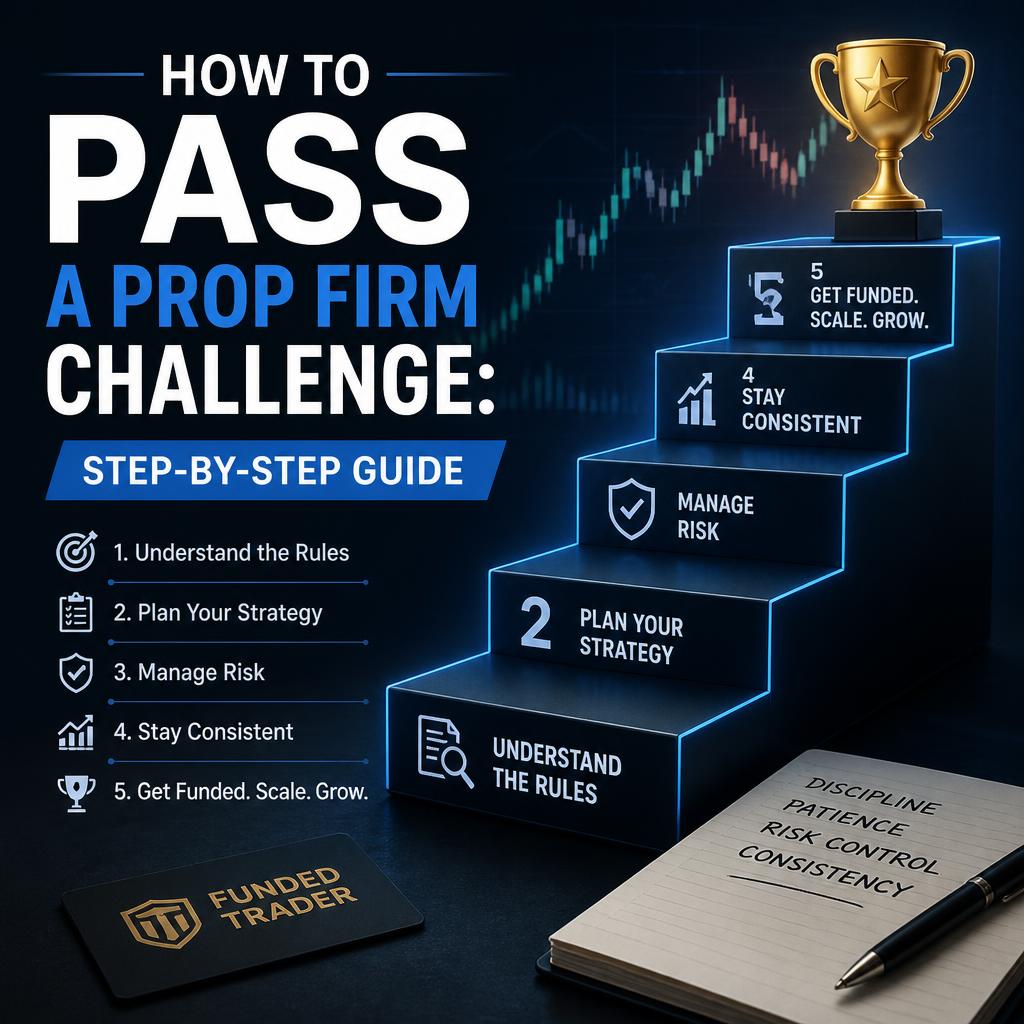
This guide walks through the entire process step by step, from choosing a firm before you spend a dollar, to the mindset and habits that carry traders through to an actual funded payout.
Step 1: Choose a Firm That Fits Your Trading Style
Before anything else, make sure the firm’s rules are actually compatible with how you trade. If you’re a swing trader, avoid firms that prohibit weekend holding. If you rely on news volatility, confirm the firm allows trading during high-impact releases. Passing a challenge starts with not setting yourself up to fail through an incompatible rule set.
- Read the full rule document, not just the marketing summary.
- Check whether the drawdown is static or trailing.
- Confirm the platform supports your usual tools and indicators.
- Research the firm’s payout reputation in independent trading communities.
Step 2: Choose the Right Account Size for Your Experience
It’s tempting to go straight for the largest account size a firm offers, since the profit split percentage looks the same regardless of size. But larger accounts often come with the same percentage-based drawdown limits translated into larger dollar amounts, which can actually increase psychological pressure for traders who aren’t used to those numbers.
If you’re newer to funded trading, consider starting with a smaller account to get comfortable with the firm’s specific rule enforcement and platform behavior before scaling up. The percentage math is the same, but the emotional experience of watching a $500 unrealized loss versus a $5,000 unrealized loss is genuinely different for most people, at least until you’ve built up experience trading under evaluation pressure.
Step 3: Build or Refine a Tested Strategy Before You Pay for a Challenge
Never enter a paid evaluation with an untested strategy. Backtest your approach across varied market conditions, then forward test it on a demo account for at least several weeks. You want statistical confidence in your win rate, average risk-to-reward ratio, and typical drawdown before you attach a firm’s real rules and a ticking clock to that strategy.
A strategy that hasn’t been tested outside of a challenge environment is essentially being tested for the first time under maximum pressure, which is the worst possible circumstance to discover a flaw.
Step 4: Define Your Risk Parameters Before Day One
Write down your specific numbers before you place a single trade in the evaluation:
- Maximum risk per trade, typically 0.5% to 1% of account balance.
- Your personal daily loss buffer, set tighter than the firm’s actual limit.
- Maximum number of trades you’ll take per day.
- Minimum risk-to-reward ratio you’ll accept on any setup.
- A rule for reducing size after a losing streak.
Having these numbers decided in advance, before emotions are involved, removes the need to make risk decisions in real time while a trade is moving against you.
Step 5: Treat the Profit Target as a By-Product, Not the Goal
This is a subtle but important mental shift. Traders who fixate on the profit target itself often start taking lower-quality trades as the deadline approaches, or increase their size to get there faster. Traders who instead focus on executing their tested process correctly, trade after trade, tend to reach the profit target as a natural consequence of good execution, without the emotional distortion that comes from staring at a countdown.
Step 6: Start Slow in the First Few Days
Many funded traders recommend easing into an evaluation rather than trading at full intended frequency from day one. Use the first several trading days to get a feel for the platform’s execution speed, spread behavior, and how the firm’s risk dashboard updates in real time. A slower start also reduces the chance of an early, costly mistake before you’ve built any profit buffer.
Step 7: Track Every Trade and Review Weekly
Keep a simple trading journal throughout the evaluation, logging entry and exit reasoning, position size, and outcome. Review this weekly, not to judge individual trades in isolation, but to spot patterns. Are your losses clustering around a specific time of day, a specific instrument, or after a previous loss? These patterns are usually invisible in the moment and only become clear on review.
Step 8: Protect Yourself From Revenge Trading
Almost every failed evaluation includes at least one trade taken specifically to recover a previous loss, rather than because it met the trader’s normal setup criteria. Build a specific rule for yourself: after any loss that hits your predefined daily buffer, or after two consecutive losses regardless of size, stop trading for the remainder of that session. This single habit prevents more failed evaluations than almost any technical adjustment to your strategy.
Step 9: Manage the Final Stretch Carefully
As you approach the profit target, resist the urge to change your position sizing or strategy just because you’re close. This is when many traders sabotage an otherwise well-executed evaluation, either by getting overly conservative and freezing up, or by getting overconfident and taking oversized positions to finish faster. Continue executing exactly the process that got you this far.
If you’re using a two-step model and clear Phase 1, treat Phase 2 with the same discipline rather than relaxing because you’ve already proven yourself once. Verification phases fail traders regularly, often because of exactly this kind of complacency.
Step 10: Prepare Mentally for the Funded Stage
Passing the evaluation isn’t the finish line, even though it feels like one. Many traders who clear a challenge struggle once real payouts are on the line, because the psychological weight of “this money could become an actual withdrawal” reintroduces pressure similar to trading personal capital. Going into the funded stage, keep the exact same risk rules that got you there. This is not the moment to loosen discipline.
Common Mistakes That Cause Failed Attempts
- Risking too much per trade in an attempt to hit the profit target quickly.
- Ignoring the firm’s specific drawdown calculation method until it’s too late.
- Overtrading out of boredom or impatience on slow market days.
- Increasing position size after a losing streak to “win it back.”
- Abandoning a tested strategy mid-evaluation in favor of an untested new idea.
- Trading through major news events without adjusting size, on firms where this is allowed but risky.
- Treating a two-phase evaluation’s second phase with less discipline than the first.
What to Do If You Fail Your First Attempt
Failing a first evaluation attempt is common enough that it shouldn’t be treated as a sign you’re not cut out for funded trading. What matters far more is how you respond. Review your trading journal from the failed attempt specifically looking for the moment risk management broke down, whether that was a single oversized position, a string of revenge trades after a loss, or simply overtrading out of impatience.
Resist the urge to immediately buy another evaluation and try again without changing anything. Take at least a few days to trade on a demo account, specifically practicing the discipline that broke down during the failed attempt, before committing money to a second try. Traders who treat each failed evaluation as a specific, diagnosable problem to fix tend to pass on subsequent attempts far more often than traders who simply keep retrying the same approach and hoping for a better outcome.
Setting Realistic Expectations for Timeline
Depending on the firm’s specific rules, a two-step evaluation with generous time limits could realistically take anywhere from a few weeks to a couple of months to complete for a trader executing patiently rather than rushing. One-step evaluations can move faster, but only for traders whose risk tolerance already comfortably fits the tighter drawdown limits typical of that format.
Setting an unrealistic internal timeline, such as expecting to pass within the first week regardless of format, often creates exactly the kind of pressure that leads to the rushed, oversized trades that end evaluations early. Give your strategy the time the firm’s own rules allow, and treat a full use of the available time limit as a legitimate, successful outcome rather than a sign of slow progress.
Frequently Asked Questions
How long does it typically take to pass a prop firm challenge?
This varies significantly by firm, format, and trading style, but many traders who pass do so within a few weeks to two months, particularly when using the full time limit available rather than rushing toward the profit target.
Is it normal to fail a challenge on the first attempt?
Yes, failing a first attempt is extremely common, even among traders who go on to pass and stay funded. What matters is diagnosing the specific reason for the failure and adjusting before the next attempt.
Should I change my strategy if I fail an evaluation?
Not necessarily. Many failed evaluations stem from risk management breakdowns rather than a flawed strategy. Review your trading journal carefully before deciding whether the strategy itself or your execution and discipline was the actual problem.
What’s the biggest mistake traders make in their first challenge attempt?
Entering the evaluation with an untested strategy and no predefined risk rules, which forces critical risk decisions to be made emotionally, in real time, under pressure, rather than calmly in advance.
A prop firm challenge rewards the trader who can execute a boring, tested process consistently under pressure, not the trader with the most exciting strategy.
Final Thoughts
There’s no shortcut that reliably replaces preparation, tested strategy, and disciplined risk management when it comes to passing a prop firm evaluation. The traders who consistently succeed treat the challenge as an extension of good trading habits they’d already built, rather than a separate game with different rules they can bend just this once.
Choose a firm whose rules fit your style, define your risk parameters before you start, track your process rather than obsessing over the profit target, and protect yourself from the emotional traps that cause most failed attempts. None of this guarantees success, since markets remain unpredictable, but it puts the odds meaningfully in your favor, and it builds exactly the habits you’ll need to stay funded long after the evaluation itself is behind you.