
The Prop Firm space has exploded over the past few years. New firms launch constantly, each promising bigger accounts, faster payouts, and easier challenges than the last. For a trader trying to get funded, this is both a blessing and a curse. More options mean more opportunity, but it also means more noise, more marketing spin, and a higher chance of picking a firm that doesn’t actually fit how you trade.
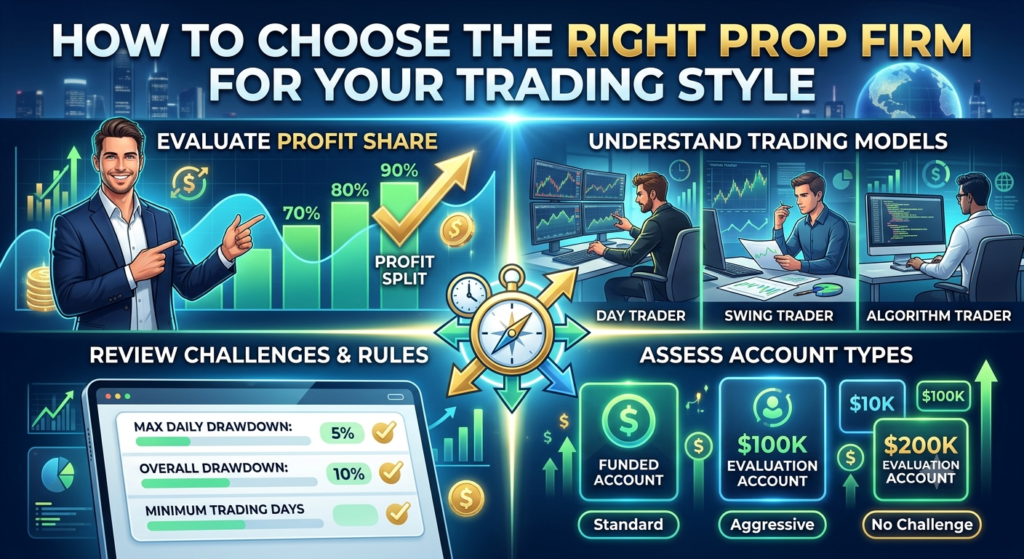
Choosing a prop firm isn’t like picking a broker. The rules you agree to will directly shape whether your strategy can even function. A scalper forced into a firm with wide spreads and a strict time-based consistency rule is set up to fail before they place a single trade. This guide walks through exactly what to evaluate, in order of importance, so you pick a firm that complements your style rather than fights against it.
Step 1: Identify Prop Firm Your Actual Trading Style
Before comparing firms, get honest about how you trade. Not how you’d like to trade, or how a YouTube guru trades, but what your backtested or demoed results actually show. Ask yourself:
• Do you hold trades for seconds or minutes (scalping), hours (day trading), or days to weeks (swing trading)?
• Do you rely on high-impact news events for volatility?
• Do you typically hold positions overnight or over weekends?
• What’s your average and maximum drawdown during a losing streak?
• Do you trade one instrument or several across different asset classes?
Your answers here determine almost everything else, because different firms are built with different trader profiles in mind.
Step 2: Check the Firm’s Rule Set Against Your Style
This is the single most important filter, and it’s the one traders skip most often because they’re distracted by profit split percentages and account size options.
Daily loss limits
If you’re a swing trader who occasionally sees a larger intraday drawdown before a position recovers, a firm with an aggressive daily loss limit could stop you out of the challenge even though your overall strategy is sound. Scalpers and day traders who close positions daily tend to fit these rules more comfortably.
Maximum overall drawdown
Some firms use a static drawdown measured from the initial balance, while others use a trailing drawdown that follows your account’s peak equity. A trailing drawdown is generally harder to manage for swing traders holding larger open positions, since unrealized gains can shrink the buffer you thought you had.
Weekend and overnight holding rules
Many firms restrict or outright prohibit holding trades over the weekend due to gap risk. If your strategy depends on multi-day swing positions, this single rule can eliminate a huge portion of firms from consideration immediately.
News trading restrictions
Firms that prohibit trading during high-impact news releases, like Non-Farm Payrolls or central bank rate decisions, are a dealbreaker for news-based strategies. If volatility around news events is your edge, confirm this is allowed before paying for any evaluation.
Consistency rules
Some firms require that no single trading day account for more than a set percentage of your total profit. This can be genuinely difficult for traders whose edge produces occasional large wins alongside many smaller or breakeven days. Understand exactly how this is calculated before committing.
Step 3: Evaluate the Challenge Structure
Prop firms typically offer one-step, two-step, or three-step evaluations, and increasingly, instant funding options with no evaluation at all. Each comes with trade-offs in cost, difficulty, and how quickly you get access to real payouts.
• One-step challenges are faster to complete but usually come with tighter drawdown limits and no separate verification phase, meaning less room for error.
• Two-step challenges are the traditional format, offering slightly more breathing room but requiring you to prove consistency twice before funding.
• Instant funding accounts skip the evaluation but often carry higher fees, lower profit splits, or more conservative risk parameters.
Match the structure to your risk tolerance and how quickly you need capital access. If you trade infrequently or need more time to hit a profit target without pressure, a two-step model with generous time limits may suit you better than a fast one-step challenge.
Step 4: Look Closely at Profit Splits and Scaling Plans
Profit splits range widely, typically between 70% and 90% in the trader’s favor. A higher headline split sounds appealing, but check whether it’s the starting split or something you only reach after scaling. Many firms start traders at 80% and increase the split as account size grows through consistent profitability.
Also examine the scaling plan itself. Some firms double your account size after a set number of profitable months with no drawdown breaches, which can meaningfully increase your earning potential over time. Others offer no scaling at all, capping your account size permanently.
Step 5: Investigate Payout Reliability and Firm Reputation
This is where due diligence really matters, because marketing claims and actual trader experiences don’t always match. Before paying for any evaluation:
• Search independent trading communities and forums for recent trader experiences, not just testimonials on the firm’s own website.
• Check how long the firm has operated and whether it has a track record of consistent payouts.
• Look for clear, published payout timelines, such as bi-weekly or on-demand withdrawals, and confirm whether these have been honored recently.
• Be wary of firms with a pattern of disputed account terminations, especially around technical rule violations reported by multiple traders.
• Confirm what trading platform the firm uses, such as MetaTrader 4, MetaTrader 5, cTrader, or a proprietary platform, and whether it supports the tools your strategy depends on.
Step 6: Compare Costs Honestly
The evaluation fee is only part of the cost equation. Factor in:
• The fee itself, and whether it’s refundable upon reaching funded status.
• Any monthly data or platform fees charged after funding.
• The realistic cost of multiple attempts, since failing and retrying is common, especially for newer traders.
• Spreads and commissions on the firm’s platform, which can quietly erode profits for high-frequency strategies.
A slightly more expensive evaluation from a firm with tighter spreads and a rule set that fits your style is often better value than a cheap challenge that’s structurally incompatible with how you trade.
Step 7: Test the Platform Before You Commit Money
Many firms offer free trials, demo access, or detailed platform documentation before you pay for an evaluation. Use this. Execution speed, slippage during volatile moments, and the general feel of the trading interface all matter more than they seem to on paper. A platform that lags during fast markets can single-handedly derail an otherwise solid strategy.
Matching Firm Type to Trader Profile
As a general guideline, though individual firms vary:
• Scalpers and high-frequency day traders tend to do better with one-step challenges, tight spreads, and firms with no restrictions on trading frequency.
• Swing traders need firms that allow overnight and weekend holding, ideally with a static rather than trailing drawdown.
• News traders should prioritize firms that explicitly permit news trading with no blackout windows.
• Conservative, low-frequency traders may prefer two-step evaluations with generous time limits and no minimum trading day requirements.
• Traders wanting fast capital access might lean toward instant funding models, accepting a lower split or higher fee in exchange for skipping the evaluation entirely.
Don’t Overlook Customer Support Quality
This factor rarely makes it into comparison articles, but it matters more than most traders expect until they actually need help. Evaluation periods involve real questions: clarifying an ambiguous rule, resolving a platform glitch, or understanding why a trade was flagged. Firms with slow or unhelpful support can turn a minor issue into a failed evaluation simply through delay or miscommunication.
Before committing, test the firm’s support channel with a genuine question, whether through live chat, email, or a community Discord server many firms now maintain. Response time and clarity of the answer tell you a lot about how that firm will treat you if something goes wrong during a live evaluation.
Consider the Firm’s Longevity and Financial Stability
The prop firm industry has seen its share of firms launching with aggressive marketing and attractive terms, only to shut down, change rules retroactively, or struggle to pay out large withdrawals once trader success rates picked up. This isn’t meant to create unnecessary fear, but it’s a real risk worth factoring into your decision.
Firms that have operated for several years, processed a large and verifiable volume of payouts, and maintain transparent communication about their business model tend to carry less risk than brand-new firms offering unusually generous terms that seem disconnected from how the underlying economics of prop trading actually work. If a deal looks significantly better than every competitor with no clear explanation why, treat that as a signal to research more carefully rather than sign up faster.
Frequently Asked Questions
Should I choose a firm based mainly on profit split percentage?
No. Profit split matters, but a slightly lower split at a firm whose rules actually fit your trading style will earn you more over time than a higher split at a firm whose restrictions cause you to fail repeatedly.
Is it worth paying more for a firm with a better reputation?
Generally, yes. A firm with a proven history of reliable payouts is worth a modest premium compared to an unproven, cheaper alternative, since the entire point of passing an evaluation is eventually getting paid.
How many firms should I research before choosing one?
There’s no fixed number, but comparing at least three to five firms against your specific trading style and risk tolerance gives you enough perspective to spot meaningful differences in rules, cost, and reputation.
Can I trade with more than one prop firm at the same time?
In most cases, yes, and many experienced funded traders do exactly this to diversify their income across multiple firms and account types, though it’s worth checking each firm’s specific terms for any restrictions.
The best prop firm isn’t the one with the biggest marketing budget. It’s the one whose rules you’d barely notice because they already match how you trade.
Final Thoughts
Choosing a prop firm is fundamentally a compatibility exercise, not a hunt for the single “best” firm on the market. The firm that’s perfect for a scalper could be a terrible fit for a swing trader, and vice versa. Take the time to genuinely understand your own trading behavior, then filter firms based on rules, structure, cost, and reputation, in that order.
Rushing into a challenge because of a flashy discount code or an influencer’s affiliate link is one of the most common and avoidable mistakes traders make. Slow down, read the firm’s rule documentation in full, and if possible, talk to other traders who’ve actually gone through funding and payouts with that specific firm. The evaluation fee is a small cost. Picking a firm that’s fundamentally incompatible with your strategy is the expensive mistake.